
Most of us know our own cities in a deeply efficient way.
We know the road to the grocery store. The parking deck behind the restaurant. The coffee shop near the dentist. The shortcut around that intersection that somehow always has something happening to it.
You can live somewhere for years and get very good at moving through it without actually looking at much of it.
That is one of the funny things about familiarity. A place can stop feeling like a place and start feeling like a series of routes.
Home to work. Home to dinner. Home to Target. Dinner to the movie. Parking deck to front door and, preferably, back again without having to remember where the car is.
Very useful.
Also a pretty good way to miss half the city you supposedly know.
THERE IS A LOT BETWEEN HERE AND THERE
"The joy of getting lost" sounds dramatic enough that somebody should be handing you a paper map and confiscating your phone.
No.
Nobody needs to miss a reservation or wander into a warehouse district for character development.
The better kind of lost is smaller than that. You know where you are. You probably know where you're going. You just haven't decided that everything between those two points is irrelevant.
Maybe the restaurant is the plan, but there is a shop next door with a window good enough to make you stop.
Maybe you came for the bookstore and keep walking because the next block looks interesting.
Maybe you sit somewhere longer than expected because the seat is good, the music is right, and whatever was supposed to happen next suddenly feels optional.
That is where wandering gets interesting.
It does not require a blank calendar or a grand sense of adventure. It just requires the outing to have a little give in it.
WE HAVE BECOME VERY GOOD AT ARRIVING
There is something funny about how precisely we can plan a place before we ever stand in it.
We can look up the menu, inspect the parking situation, read reviews, save the address, check the hours, find the entrance and know which pastry everybody on the internet thinks we should order.
Useful? Absolutely.
Nobody is campaigning against clear parking instructions.
But it does mean an outing can become very destination-heavy. Get to the place. Do the thing. Leave the place.
The city around it becomes scenery.
And sometimes the part worth remembering was not the thing with the reservation.
It was the strange little stationery store two doors down.
The courtyard you could not see from the street.
The antique booth with an alarming number of ceramic cats.
The bakery you walked into because something smelled good and you had nowhere more important to be for the next few minutes.
Those things are hard to search for in advance because their entire appeal is that you noticed them.
CURIOSITY CAN BE SMALL
Not every interesting thing needs to become a whole thing.
This is important.
You can walk into a shop because the window was good and leave without buying anything.
You can read the menu at a restaurant you are not eating at.
You can spend a few minutes flipping through old magazines, looking at jewelry, smelling candles, inspecting an extremely impractical chair, or staring at a building because the tile work is ridiculous.
You do not have to save it for later.
You do not have to turn it into a recommendation.
You do not have to decide whether this is now one of Your Places.
It was interesting for a minute. That counts.
There is a kind of pleasure in letting your attention be that unserious.
Adult life asks us to justify plenty. The errand has a purpose. The appointment has a purpose. The purchase has a purpose. Even leisure can start acting like it needs objectives if we're not careful.
See the exhibit. Try the restaurant. Finish the trail. Get the good coffee. Check the thing off.
Meanwhile, there is a whole category of enjoyment built around "Huh. What's over there?"
That deserves to survive.
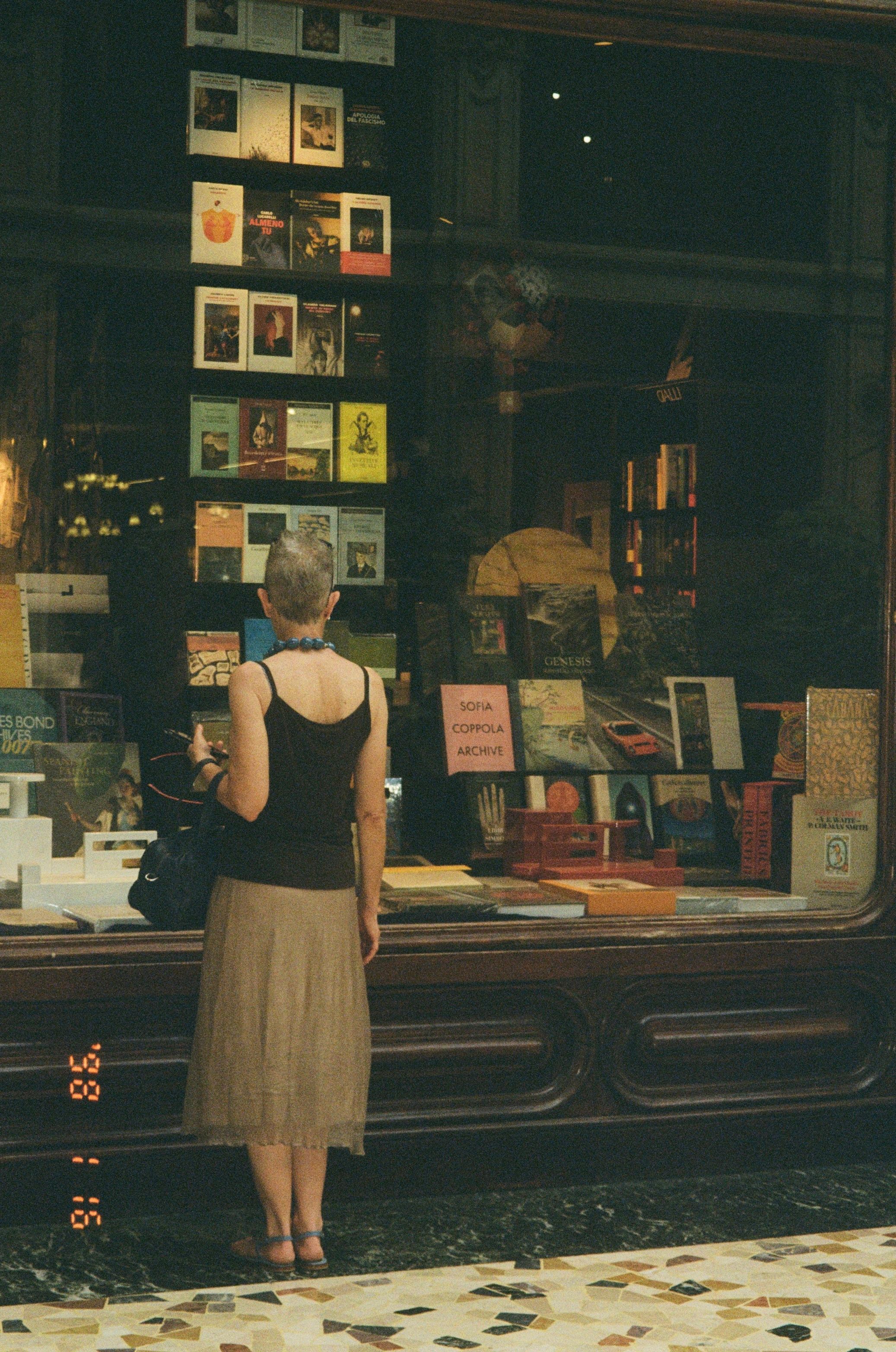
SOMETIMES YOU ONLY KNOW A NEIGHBORHOOD FROM THE CAR
A city looks different at walking speed.
Not prettier, necessarily. Just more detailed.
The block you usually drive through has a secondhand store tucked behind the pharmacy. There is a tiny patio beside the place you have ordered takeout from ten times. The building you thought was offices has a gallery downstairs. The street you considered "basically just the way to the movie theater" turns out to contain an entire little world once you are not trying to make the next light.
This is how familiar places get some dimension back.
Not because you uncovered a secret nobody else knew.
Please. The people who live on that block know it is there.
You noticed something you had not noticed before.
That is enough.
Sometimes we know our own cities at the scale of errands. Wandering lets us know them at the scale of details.

DO NOT MAKE WANDERING ANOTHER ASSIGNMENT
There is, of course, a very easy way to ruin this.
Plan it to death.
Create a six-stop "spontaneous wandering" itinerary. Research every storefront. Save twelve possibilities. Build a route optimized for maximum serendipity.
Now we are doing project management in cute shoes.
The outing can have an anchor. In fact, anchors are useful.
Lunch. A museum. A market. A bookstore. Coffee somewhere worth sitting.
Go there.
Then leave a little air around it.
You do not need to promise yourself that you will discover anything. You do not need to take the scenic route if the scenic route turns out to be ugly. You do not need to force a detour because wandering sounded good when you were sitting at home.
If nothing catches your attention, fine.
You still went where you wanted to go.
But if something does?
You are allowed to follow it without asking whether it belongs in the plan.
THE CITY DID NOT GET BORING. YOUR ROUTE GOT FAMILIAR.
There is a point, after you have lived somewhere long enough, when it is easy to start believing you have already seen it.
Usually what you have seen are your parts of it.
Your restaurants. Your shopping center. Your regular roads. The section of downtown where you always park. The neighborhood you cross on the way to somewhere else.
Familiarity can be comforting. That is part of why we build routines in the first place.
But there is a difference between knowing a city and having a route through it.
Sometimes the easiest way to feel a little curiosity about where you already live is not to find a brand-new destination.
It is to stop treating every familiar street like a hallway to somewhere else.
You can know exactly where you are and still get a little lost.
That is the good part.